Voice AI & Real-time Agents

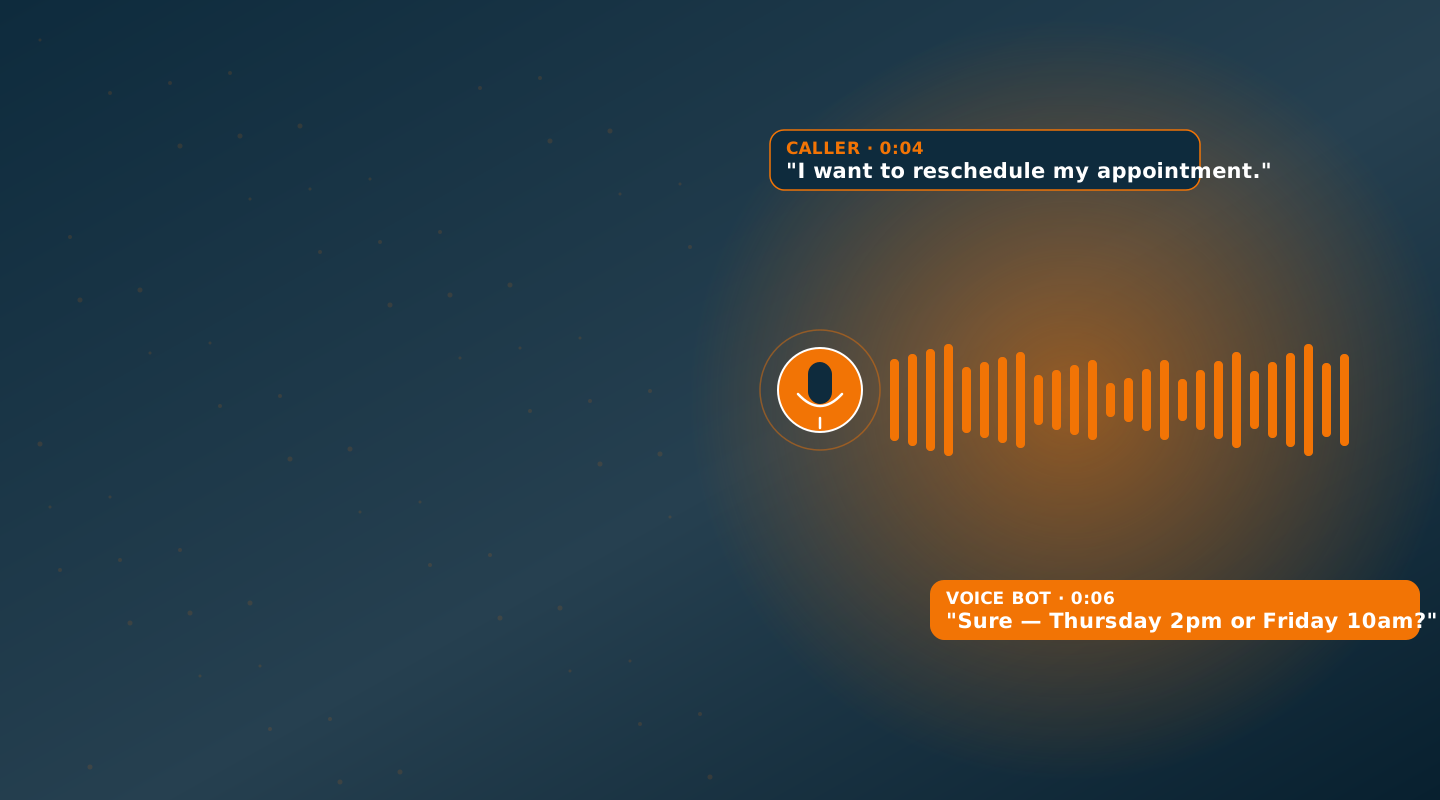
From transcription pipelines to real-time voice agents that handle calls end-to-end — built with low latency, accent robustness, and clear escalation paths to humans.

Voice AI

Voice interfaces that actually understand callers.

Voice systems engineered for sub-second response, robust transcription, and graceful human escalation.

Common signs your team is overdue for voice ai:

  • Latency that breaks conversation flow
  • Speech-to-text that fumbles names, accents, and domain terms
  • Brittle IVR trees customers hate
  • No way to measure call outcomes vs. cost per minute

What we build for voice ai:

  • Real-time voice agents with sub-second turn latency
  • Custom vocabulary / acoustic adaptation for your domain
  • IVR replacement with natural-language routing
  • Post-call summaries, action items, and CRM updates
  • Seamless human handoff with full call context
Talk to an engineer

Capabilities

Where voice AI earns trust

Sub-second voice agents — outcomes our clients keep coming back for.

Inbound call handling

Triage, qualify, and route — book meetings or escalate cleanly.

Outbound reminders

Appointment confirmations, payment reminders, surveys — at scale.

Meeting transcription

Multi-speaker transcripts with summaries and action items piped to your tools.

Compliance monitoring

Detect required disclosures and risky language across all calls.

How we deliver

Build a voice agent

01

Listen to real calls

Profile call types, common asks, vocabulary, and the emotional shape of conversations.

02

Design the dialogue

Decide what the agent handles, what it escalates, and how it hands off.

03

Build & tune

STT, LLM, TTS, telephony. Tune latency at every hop.

04

Pilot & scale

Shadow live calls, take a slice, measure resolution rate, scale up.

Tools & platforms we use:

Whisper Deepgram AssemblyAI OpenAI Realtime ElevenLabs Twilio LiveKit Vapi Postgres

FAQ

Questions teams ask us about Voice AI

How low can latency go?
With a tuned pipeline (Realtime API or streaming STT + small LLM + low-latency TTS), we routinely hit sub-700ms turn latency.
Can the agent handle accents and noisy environments?
Yes — we test against representative calls from day one and tune acoustic models / vocabulary accordingly.
How long does it take to get to production?
Most projects ship a real, usable system in 3–6 weeks. Discovery is 1–2 weeks; build sprints are weekly with demos.
Will my data be used to train models?
No. We default to enterprise tiers (OpenAI, Anthropic, Bedrock, Vertex) that don’t train on your data. For sensitive use cases, we deploy open-weight models on your infrastructure.
How do you control costs?
We design cost-aware from day one — model routing (cheap model first, escalate when needed), caching, batch processing, and per-user budgets with alerts.
Can you work with our existing engineering team?
Yes. We embed alongside your team, transfer ownership progressively, and document everything we build.