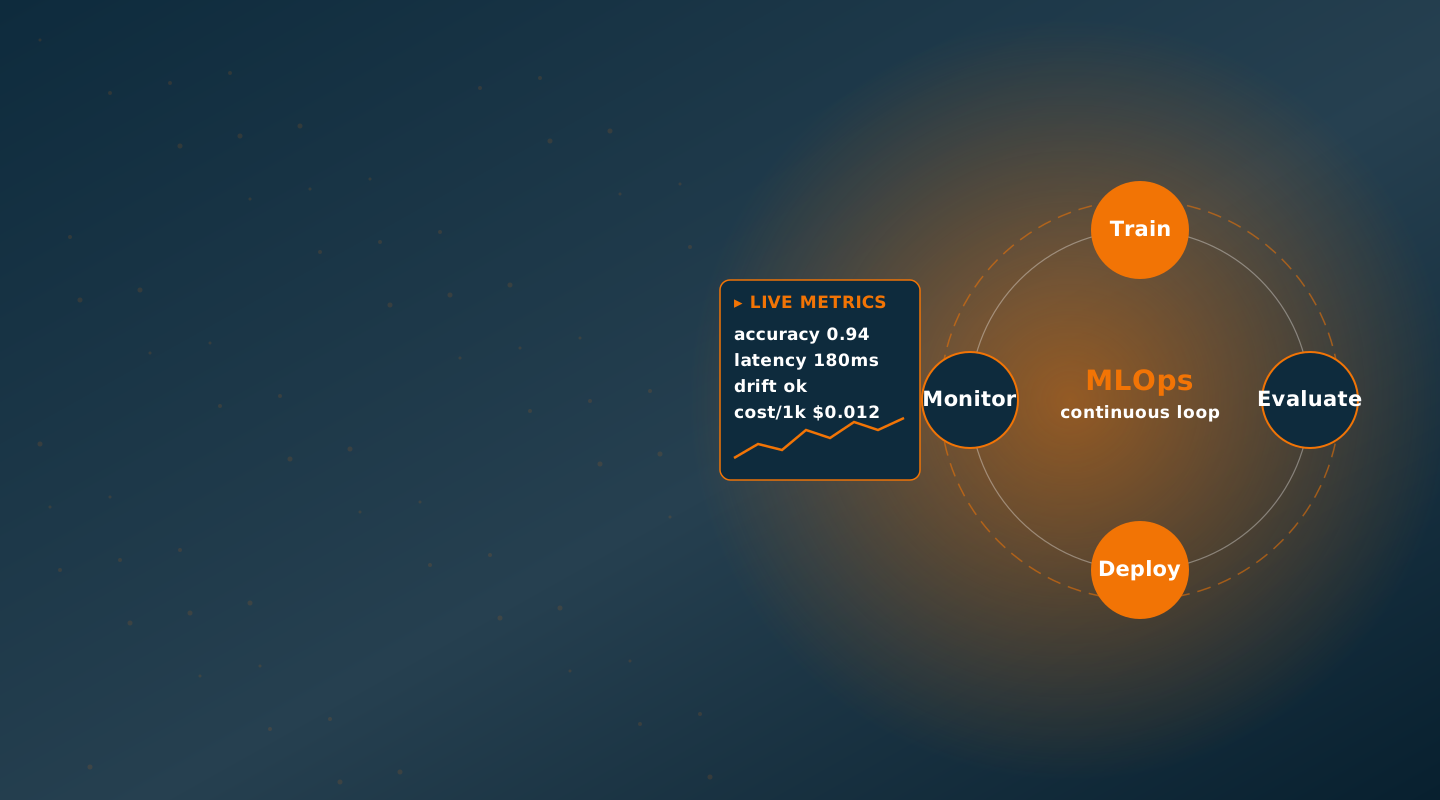
MLOps & Model Deployment

CI/CD for models, feature stores, eval gates, monitoring, and rollback. The unglamorous infrastructure that turns experiments into reliable systems.

MLOps

From notebooks to production you can sleep at night with.

A boring, reliable ML platform — versioned, observable, and easy to roll back.

Common signs your team is overdue for mlops:

  • Models trained on a laptop, deployed by hand, monitored by hope
  • “It worked last week” — no reproducible training pipeline
  • Drift goes undetected for weeks; quality silently rots
  • Rollbacks require a hero on a Saturday

What we build for mlops:

  • Reproducible training pipelines with data + code + config versioning
  • Eval gates in CI — models can’t deploy if metrics regress
  • Feature stores for offline / online consistency
  • Online monitoring: latency, error rates, prediction drift
  • Canary + shadow deployments with one-click rollback
Talk to an engineer

Capabilities

Where MLOps pays for itself

Boring, reliable ML platform — outcomes our clients keep coming back for.

Drift detection

Alert before a degraded model affects business KPIs.

Continuous training

Scheduled retraining with eval gates and automated promotion.

Eval as CI

Block bad models from production the same way you block bad code.

Compliance & audit

Lineage, model cards, and documentation that satisfy regulators.

How we deliver

From notebook to production

01

Audit

How are models trained, deployed, and monitored today? What hurts?

02

Plan

Define the platform shape: tooling, pipelines, monitoring, governance.

03

Implement

Migrate one model at a time. Each migration leaves the platform stronger.

04

Operate

On-call playbooks, dashboards, drift alerts.

Tools & platforms we use:

MLflow Weights & Biases Kubeflow BentoML Triton SageMaker Vertex AI Databricks Feast Evidently Kubernetes

FAQ

Questions teams ask us about MLOps

Do we need Kubernetes?
Not always. For many teams, managed services (SageMaker, Vertex) plus a thin custom layer beats running k8s. We pick the boring option that fits your team’s skills.
How do you handle the LLM era — when “the model” is an API?
Same principles apply: versioned prompts, eval gates, online monitoring, rollbacks. We treat prompts and retrieval configs as first-class artifacts.
How long does it take to get to production?
Most projects ship a real, usable system in 3–6 weeks. Discovery is 1–2 weeks; build sprints are weekly with demos.
Will my data be used to train models?
No. We default to enterprise tiers (OpenAI, Anthropic, Bedrock, Vertex) that don’t train on your data. For sensitive use cases, we deploy open-weight models on your infrastructure.
How do you control costs?
We design cost-aware from day one — model routing (cheap model first, escalate when needed), caching, batch processing, and per-user budgets with alerts.
Can you work with our existing engineering team?
Yes. We embed alongside your team, transfer ownership progressively, and document everything we build.