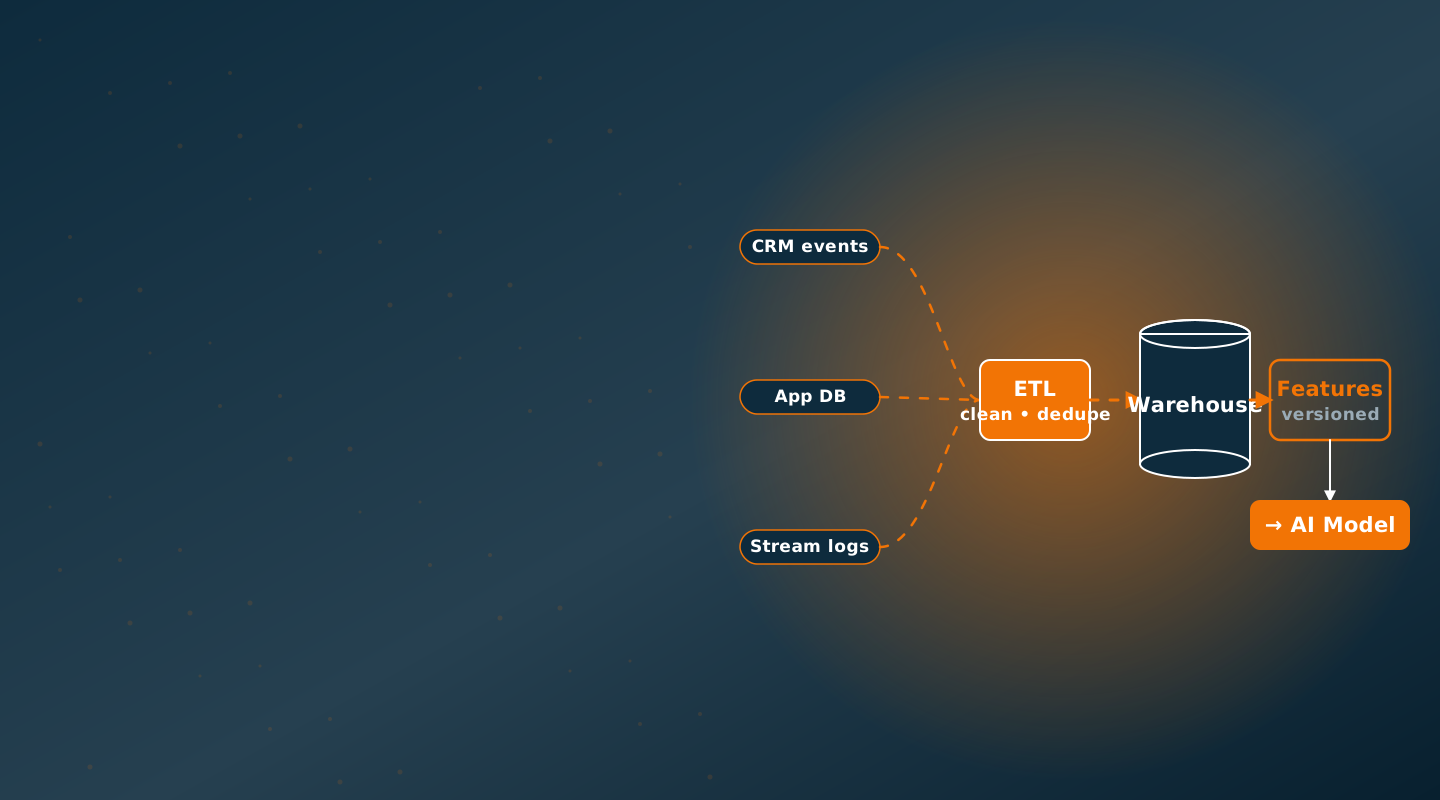
Data Engineering for AI

Ingestion, transformation, embeddings, vector stores, and governance — the foundations every successful AI system actually depends on.

Data Engineering for AI

AI is only as good as the pipes feeding it.

Reliable data infrastructure that AI systems can trust — and that humans can audit.

Common signs your team is overdue for data engineering for ai:

  • Data trapped in 12 systems with no single source of truth
  • Pipelines that fail silently — quality issues found by users, not engineers
  • Vector stores that go stale within days of launch
  • No data contracts — schemas change and downstream models break

What we build for data engineering for ai:

  • Ingestion from SaaS, databases, files, and event streams
  • Transformation in dbt / SQL / Python with tests and lineage
  • Embedding pipelines with refresh schedules and incremental updates
  • Vector store ops: chunking, indexing, hybrid retrieval, evals
  • Governance: PII redaction, access controls, retention policies
Talk to an engineer

Capabilities

Foundations AI builds on

Reliable foundations — outcomes our clients keep coming back for.

Streaming ingestion

Real-time pipelines for low-latency features and live retrieval.

Batch transformations

Reliable nightly transforms with tests, lineage, and ownership.

Embedding refresh

Keep your vector index in sync with source content changes.

PII handling

Detection, redaction, and tokenization before data ever reaches a model.

How we deliver

Foundation-first

01

Inventory

Where is the data, who owns it, what shape is it in, what can we use?

02

Pipe

Build the smallest set of pipelines that powers the highest-value AI use case.

03

Govern

PII, access, retention, audit. Set the rules before the volume grows.

04

Evolve

Add datasets, contracts, and consumers as new AI use cases come online.

Tools & platforms we use:

Airflow Dagster dbt Fivetran Airbyte Kafka Snowflake BigQuery Postgres pgvector Pinecone

FAQ

Questions teams ask us about Data Engineering for AI

Do we need a vector database?
Often pgvector or another extension on your existing Postgres is enough. We avoid adding new datastores unless they earn their place.
How do you handle PII in the AI path?
Detection + redaction at ingestion, tokenization where reversibility is needed, and tight access controls on anything that reaches a model.
How long does it take to get to production?
Most projects ship a real, usable system in 3–6 weeks. Discovery is 1–2 weeks; build sprints are weekly with demos.
Will my data be used to train models?
No. We default to enterprise tiers (OpenAI, Anthropic, Bedrock, Vertex) that don’t train on your data. For sensitive use cases, we deploy open-weight models on your infrastructure.
How do you control costs?
We design cost-aware from day one — model routing (cheap model first, escalate when needed), caching, batch processing, and per-user budgets with alerts.
Can you work with our existing engineering team?
Yes. We embed alongside your team, transfer ownership progressively, and document everything we build.